What is osteoarthritis?
Cartilage is the smooth, firm layer that covers the ends of your bones where they meet. In osteoarthritis, that layer thins and roughens under years of load. The bone below can thicken and form spurs, and the joint lining can become irritated.
The result is pain when you use the joint, stiffness after you rest, and a joint that may grind, click, or swell. Symptoms often come and go in flares.
Osteoarthritis by joint
Wear-related arthritis feels a little different in each joint:
- Knee: pain on stairs, when you rise from a chair, or after a long walk
- Hip: a deep ache in the groin or front of the thigh, and trouble putting on socks or shoes
- Shoulder: pain and lost motion when you reach overhead or behind your back, often with an ache at night
- Ankle: stiffness and swelling, often years after a bad sprain or fracture
- Hand: aching or bony bumps at the finger joints or the base of the thumb, and a weaker grip
How we evaluate a joint with osteoarthritis
An X-ray shows the space between the bones. Diagnostic ultrasound adds what an X-ray misses: fluid in the joint, an irritated lining, and the tendons and ligaments around it.
Pain near a worn joint does not always come from the arthritis. Ultrasound helps us tell whether the pain comes from the joint or from the tendons and ligaments around it, so treatment is directed where the pain starts.
Our osteoarthritis treatment options in St. Louis
The aim is less pain and better use of the joint, and for many patients, to avoid or delay joint replacement. We treat osteoarthritis with:
- PRP injections into the joint
- Bone marrow concentrate (BMAC), drawn from your pelvic bone and processed in the office
- PRP and bone marrow concentrate together, for more advanced joint damage
- Prolotherapy, mainly for knee osteoarthritis
- A rehabilitation plan to strengthen the muscles that support the joint
Osteoarthritis care at our Chesterfield office
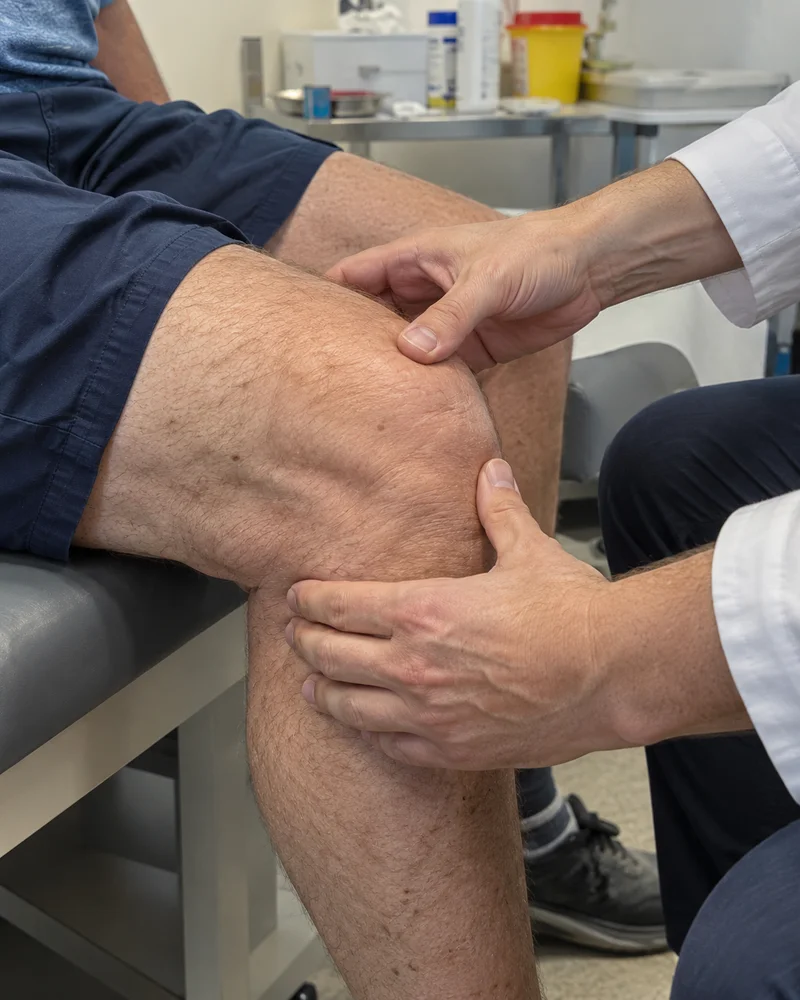
We start with the joint that limits you most. Your provider asks how far you can walk, what you have tried, and which activities you want to return to. Next, we examine the joint and scan it with diagnostic ultrasound.
Your provider will explain clearly how worn the joint looks and which options make sense at that stage. If an injection is unlikely to help, we will let you know.
Questions about Osteoarthritis Treatment in St. Louis
Can you treat bone-on-bone osteoarthritis?
We do see patients with bone-on-bone joints. Whether treatment can help depends on the joint and how you use it, so we examine you and review your imaging before we recommend a treatment plan.
How is osteoarthritis different from rheumatoid arthritis?
Osteoarthritis comes from wear and damage inside a joint. Rheumatoid arthritis is an autoimmune disease that a rheumatologist manages with medicine.
Is there an alternative to joint replacement?
For some patients, injections and rehabilitation may help delay or avoid a replacement. We offer both.
Do I have to give up running or golf?
Not always. Many people with osteoarthritis stay active with changes to how much and how often they load the joint. Your provider can help you plan that.
Have I waited too long for treatment?
Not necessarily. The options differ at each stage, and an exam shows where your joint is now.