Which parts of the knee can PRP reach?
Your knee is more than one joint surface. Cartilage covers the ends of the thigh bone and shin bone. Two C-shaped pads, the menisci, sit between them. Ligaments hold the bones together, and the patellar and quadriceps tendons connect the kneecap to the muscles that straighten your leg.
Pain can start in any of these structures. PRP is a concentrate of your own platelets, prepared from a small blood sample, and we place it into the one structure that is injured.
How we use PRP for knee pain in St. Louis
We use PRP for knee pain from several causes. The ones we treat most often are:
- Osteoarthritis, where the cartilage has worn thin
- Tendonitis of the patellar or quadriceps tendon
- Ligament sprains and partial ligament tears
- Long-standing knee pain after an old sports injury
When PRP may not be the right fit for your knee
Some knees need more than platelets. When cartilage damage is severe, we may recommend adding bone marrow concentrate to the PRP. Other knees are better suited to prolotherapy or a period of physical rehabilitation.
Why ultrasound guidance matters in the knee
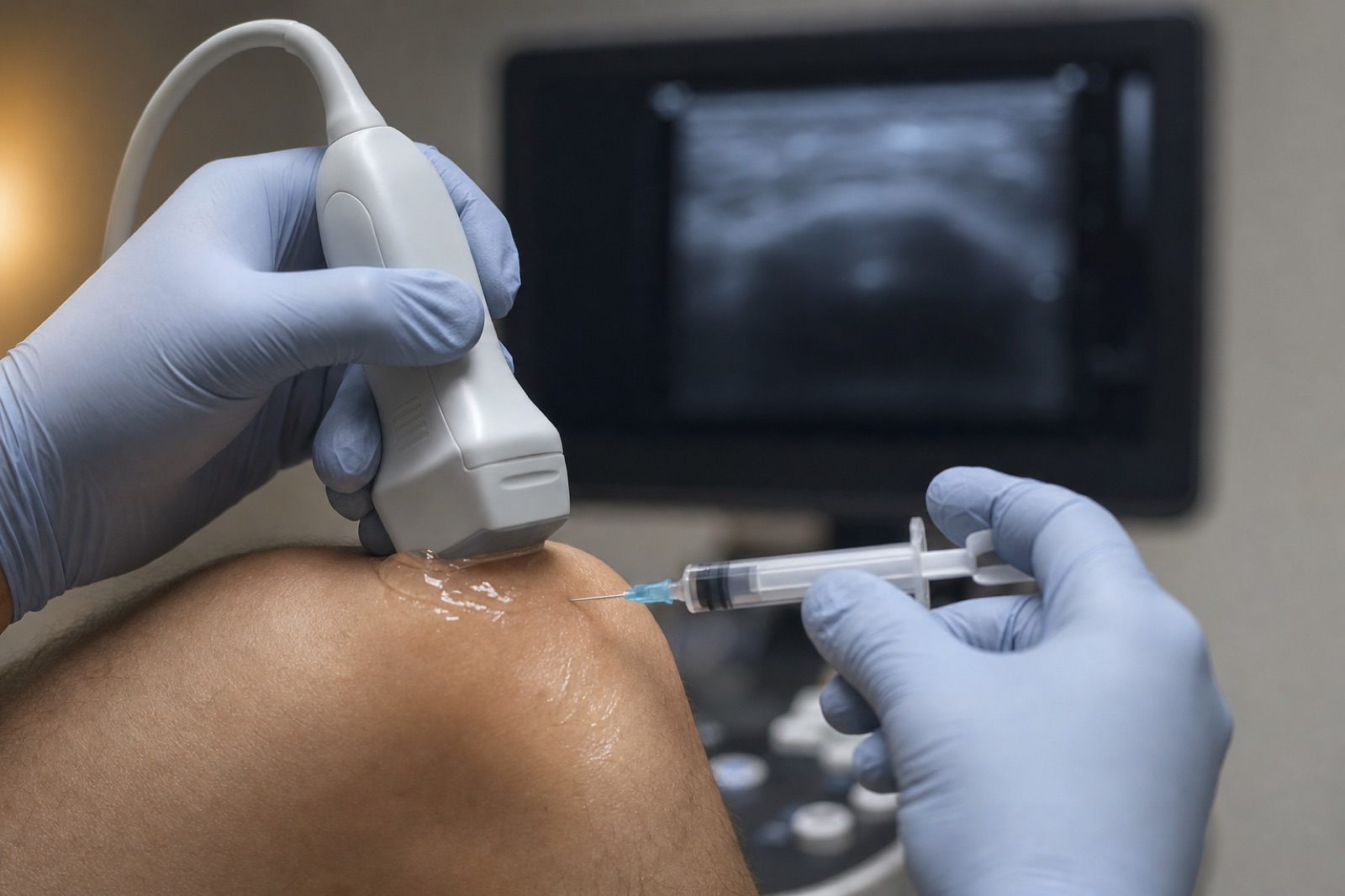
An arthritic knee needs the injection inside the joint space. A sore patellar tendon needs the injection in the tendon, not the fat pad behind it. Ultrasound shows these layers live on the screen, so your provider can watch the needle reach the right one.
The same scan helps at the exam. It can show fluid in the joint, a thickened tendon, or a torn ligament fiber before you and your provider decide on treatment.
Your knee visit at our Chesterfield office
Bring any knee X-rays or MRI reports, a list of the injections and therapy you have already tried, and shorts or loose pants so we can examine the whole knee. Your provider will ask when the pain started, what makes it worse, and whether the knee swells, locks, or gives way.
If you proceed with PRP after the exam and ultrasound, the blood draw and the knee injection are performed in our office.
Insurance covers your consultation visit. At that visit we explain the cost of any treatment we recommend, so you can decide with the full picture.
Questions about PRP for Knees in St. Louis
Can PRP help a knee that has arthritis in it?
We treat knee osteoarthritis with PRP, among other options. How much it can help depends on how much cartilage is left, which we evaluate before we recommend it.
Can I have PRP in both knees on the same day?
Ask your provider at the consultation. The answer depends on your exam and on what each knee needs.
Will I need a brace or crutches after a knee injection?
You receive instructions from your provider for walking, activity, and exercise that fit your knee and the area treated. You leave with them in writing.
Should I stop taking anti-inflammatory medicine first?
Tell us every medicine you take when you book. We provide clear instructions before the day of your injection.
I was told I need a knee replacement. Can I still have a consultation?
Yes. A consultation can serve as a second opinion. We provide an honest view of what nonsurgical care can and cannot do for your knee.